
Sep 15, 2026
The Bike That Changed Rodriguez
How a lunch conversation, 30 purple bicycles, and one enormous gamble changed the direction of our company.
The year was 1996. R+E Cycles was still primarily selling bicycles from big brands like Bianchi, Kona, LeMond, Scott and others. Rodriguez bicycles were a much smaller part of our business. We built Rodriguez bicycles, but they were custom only, and they were considerably more expensive than the production bikes we sold.
There was a problem, though.
We had a lot of women customers, and the big production brands had almost nothing that fit many of them well.
Our then co-owner, Estelle Gray, was well known in women’s cycling and triathlon. Because of that, a lot of women came to R+E looking for a new bicycle. Trying to fit them onto the production bikes available at the time was a constant exercise in compromise.
The bicycle industry had a sizing problem
On average, women tend to have more of their height in their legs and less in their torso than men. That meant bicycles designed around average male proportions often created too long a reach to the handlebars for our women customers.
Height presented another problem.
The average man is around 5’9”. The average woman is around 5’3½”. Yet many of the big brands designing around men’s averages didn’t even offer a bicycle that properly fit someone under about 5’4”. Unless a woman could afford a custom bicycle, we often ended up trying to modify the fit of a bike that simply wasn’t designed for her proportions.
We knew this was a problem. What we didn’t know was that trying to solve it was about to change our company.
“Why don’t we make one?”
In September of 1995, Marcie, Estelle and I went to the big bicycle trade show in California, as we did every year back then.
One day over lunch, Estelle and I were once again talking about how the bicycle industry simply didn’t offer a production bike designed around women’s proportions.
Out of the blue, Marcie said:
“Well, we have a frame shop. Why don’t we make a production bike for women?”
That was a very different way of looking at the problem.
Marcie did all of the accounting for R+E. Estelle and I shared the sales, service and everyday “bike shop stuff.” Estelle and I were so immersed in the bicycle industry that we’d gotten stuck in the thinking that a small builder like us couldn’t possibly compete with mass production in Taiwan.
Marcie came at it with a fresh perspective.
People knew Estelle as a prominent name in cycling, so Marcie suggested we call the bike the Stellar, tying the name back to Estelle. By the end of lunch, what had started as another conversation about an industry problem was turning into a plan.
Maybe we actually could do this.
We had one advantage the big companies didn’t
We had fit data....lots of it!
We’d been fitting women and men since 1973, and we’d been storing detailed fit information since 1983. By 1995, we had more than a decade of measurements from actual riders to draw from. So we didn’t have to guess what sizes and proportions these bicycles should be. We could look at the people we’d actually fitted over the years and design the Stellar around what we’d learned.
We also had our own frame shop and relationships with component suppliers.
So we came up with a plan.
We would build 30 bicycles, in three batches of 10.
There would be three sizes, designed around the proportions we’d been seeing in our women customers, covering riders from about 4’10” to 5’6”.
We’d build one of each size first for customers to test ride.
The price would be $995, about one-third the price of one of our custom bikes at the time, and competitive with some of the higher-end production bikes we were already selling.
And we’d keep a chalkboard in the office with 10 slots.
As customers ordered bikes, we’d write the sizes on the board. Once all 10 slots were filled, we’d build those 10 bikes and start filling the next 10 slots.
Thirty bikes for the season.
That was the plan.
Here’s the part our customers didn’t know
Looking back, I probably need to explain just how big a gamble 30 bikes was for us.
Estelle, Marcie and I had bought R+E Cycles out of bankruptcy in 1993.
None of us had any money.
“Operating on a shoestring” might actually make our financial situation back then sound more comfortable than it was. There were a couple of times when I had to put payroll on my credit card.
In all of 1995, we sold about 40 custom Rodriguez bicycles.
Now we were proposing to build 30 Stellars on top of those 40.
There was another important difference.
When we ordered bicycles from companies like Bianchi, Kona and Scott at the September bike show, they would arrive at our shop in January, February and March. We didn’t even have to start paying for them until June. Then we could make payments through the following September.
The Stellar didn’t work that way.
Nobody was financing this experiment for us.
We had to buy the frame tubing, forks, rims, hubs, cranksets, brake levers and all the other components ourselves, up front. Only the labor would be paid for as we built the bikes.
For a little company only two years out of bankruptcy, 30 bikes wasn’t a “small production run.”
It was a very tall mountain. And we had no idea whether anyone was going to buy them.
So we went shopping
By the end of that lunch, our trip to the bike show suddenly had a mission.
We needed short crank arms. Brake levers for smaller hands. Rims. Hubs. Components. Frame tubing. Forks. There are a LOT of parts in 30 complete bicycles.
More importantly, we needed to buy all of this at prices considerably lower than we normally paid through our regular distributors, or the whole idea wouldn’t work.
I was able to team up with Jeff Lindsay of Mountain Goat Cycles to buy high-quality frame tubing from Japan at a fantastic price.
Then I got lucky. I found a distributor who had a small supply of exactly the forks we needed, and he was trying to get rid of them at a discount.
By the time we left the show, we’d managed to secure what we needed for 30 bicycles.
The race was on.
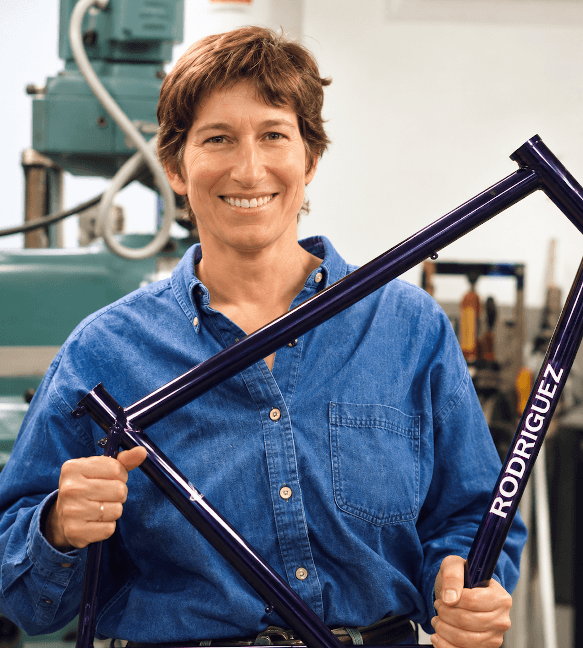
Estelle holding one of the original Stellar frames -circa 1996
Stellar Purple
By the end of February 1996, we had built the prototype frames in our first 3 sizes. We painted them a color that’s now referred to around here as Stellar Purple and built them into complete bicycles.
Those three prototypes became our test-ride bikes. A customer could ride the different sizes, and we could determine which Stellar fit her best before putting her size on the chalkboard.
We announced the Stellar in our February/March 1996 newsletter and our 1996 catalog. We thought we’d be doing pretty well if we sold all 30 before the end of the season.
Then we started filling in that chalkboard.
The first 10 slots filled almost immediately.
So we put up the next 10.
Those filled within a few days.
We added the final 10.
They filled too.
We sold all 30 Stellars before we could even finish building the first batch of 10.
Apparently we’d found a problem that a lot of other people wanted solved too.
Okay…now what?
Thirty bikes had been the plan.
But people still wanted Stellars.
So we decided to add another 20.
Selling those additional 20 turned out to be easy.
Building them was not.
We had carefully sourced enough tubing, forks and components for exactly 30 bicycles. Suddenly trying to find everything for another 20, at the right prices and on short notice, was exceptionally difficult.
We learned an important lesson about production that year:
Deviating from the plan is expensive.
It was a lesson we’d remember.
For 1997, instead of planning for 30 Stellars, we planned for 100. We added a fourth size for taller women.
They sold too.
That same year, we introduced a production tandem, the Toucan, designed to fill another niche we saw in the market: a high-quality tandem at a lower price than our custom tandems.
It experienced the same kind of success.
We were beginning to realize something.
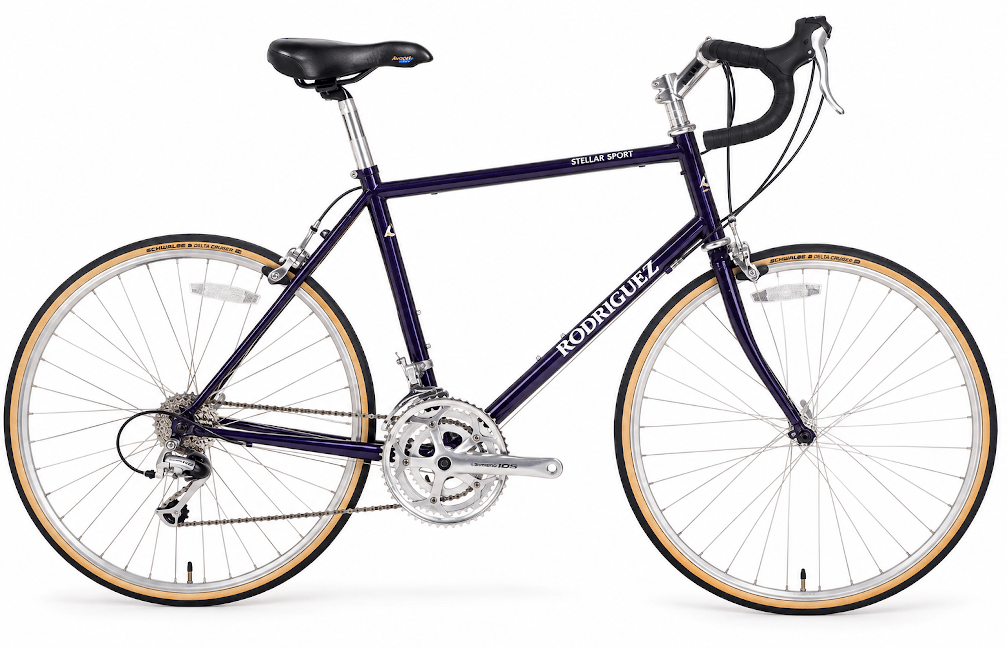
Stellar Sport -circa 2000
Maybe a little company could compete
The Stellar proved to us that with good planning and some discipline, we actually could compete with the big companies and their mass-production model.
We didn’t have to compete by doing what they did.
We could compete by doing something they couldn’t.
In 1998, we introduced the Arrow for men.
In 1999 came the Stellar Tour for women and the Adventure Tour for men. We also expanded the Arrow and Stellar with “race” versions using higher-end components and lighter tubing.
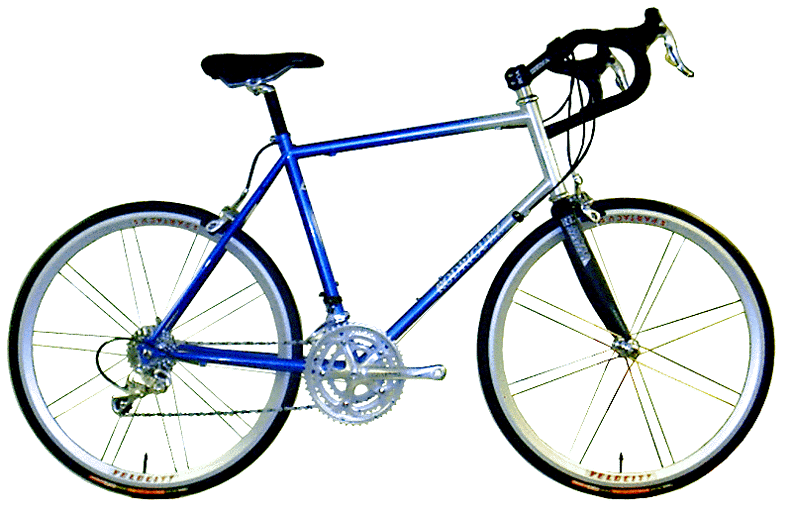
Stellar Race -circa 2000
And something interesting started happening. Sales of the big production brands began to fade as more of our customers chose the better-fitting, hand-built Rodriguez bikes instead.
By 2003, just seven years after we introduced the Stellar, about 95% of the bicycles we sold were Rodriguez.
Those first 30 purple bikes had completely changed our business.
The Stellar taught us something else
As we sold more and more Stellars, something became apparent.
Our original thinking wasn’t quite right.
Average proportions are useful for predicting bicycle fit, but averages aren’t rules.
Estelle had a rather colorful way of making this point. She used to say:
“The average person has one breast and one testicle.”
That was Estelle. She could make a point in a way you weren’t likely to forget.
Her point was that big companies have to design around averages.We didn’t.
The proportions we’d originally thought of as “women’s” proportions fit some men perfectly too. I’m one of them. Like many women, I have more of my height in my legs and less in my torso. And, of course, there are men under 5’4”, just as there are women whose proportions fall closer to the male averages.
Over time, we realized that labeling a bicycle size as being for a “man” or a “woman” wasn’t really accurate. It’s not about gender. It’s about the proportions of the individual rider. And unlike a big bicycle company trying to design one bike for thousands of people, we didn’t have to build for the average person. We could build for the person standing in front of us.
That realization would eventually lead us somewhere we couldn’t have imagined when we drew those first 10 spaces on a chalkboard.
From 30 bikes to thousands
By 2006, when we retired the Stellar name and incorporated its sizes into our new NextFit sizing system, we had sold thousands of purple Stellars.
Honestly, in 1996 we were just hoping we could sell 30.
What I really love is that we still see those purple bikes riding around Seattle today. Some are still being ridden by their original owners. Others have been passed along and are now being ridden by people who weren’t even born when we built them.
Every once in a while, I’ll see that familiar Stellar Purple go by and think about that lunch in California in 1995. We certainly didn’t know it then, but those first 30 bicycles changed Rodriguez.
And Estelle?
Longtime R+E customers will remember Estelle.
She had been part of the company since the 1970s, and she was a big personality in the Seattle cycling community. Her reputation, particularly in women’s cycling, was one of the reasons so many women found their way into our shop in the first place.
Estelle left R+E Cycles and moved to California in 2003, largely disappearing from the bicycle industry. I know some longtime customers have wondered over the years what became of her.
Estelle passed away in 2024. But there’s a little piece of her history still rolling around Seattle.
Marcie’s suggestion to name that bicycle the Stellar tied it to Estelle. And although the Stellar name disappeared from our catalog in 2006, the bicycles certainly didn’t. Neither did the sizes. Those original Stellar sizes live on today as our 1S, 2S, 3S and 4S NextFit sizes.
Want to go back to 1996?
We’ve kept a lot of our old Rodriguez materials over the years, including the original newsletter and catalog where we introduced the Stellar.
It’s fun to look back at them now, knowing that we were hoping to sell 30 of those purple bikes, with absolutely no idea what we’d just started.
The Stellar also started getting some attention outside our little shop. Bicycling Magazine reviewed it in 1997, and by 2000, Seattle Magazine was writing about the Stellar and reporting that we were selling almost 200 of them a year.
If you’d like to dig into the history, here are all four:
Our February/March 1996 newsletter
Our 1996 Rodriguez catalog
Bicycling Magazine’s 1997 Stellar review
Seattle Magazine’s 2000 Stellar article
Thirty years later
The chalkboards are gone.
But there’s something about the original Stellar idea that hasn’t changed at all.
At Rodriguez, we still build your bicycle after you buy it, not before.
There isn’t a warehouse full of already-built Rodriguez bicycles waiting for us to find a rider who happens to fit one.
Today, our NextFit system helps us determine what your bicycle needs to be, and then we build it for you.
It’s a much more sophisticated system than those three purple bikes we rolled out in 1996.
But in a way, it all started with the same question Estelle and I were complaining about over lunch:
Why should the rider have to adapt to the bicycle?
Thirty years ago, Marcie’s answer was basically:
Maybe they shouldn’t.
Maybe we should build the bicycle to fit the rider.
Turns out, she was onto something.
Next time: We’ll get into the story of NextFit, how we developed 20 sizes, and why we still believe the bicycle should fit you, rather than the other way around.

Bicycles Hand Built in Seattle Since 1973
5627 University Way NE Seattle, WA 98105


