
The Bicycle Fitting Revolution
Jun 22, 2026Part 2: The Evolution of a Revolution
If every custom bicycle is supposed to be built around the rider, shouldn't the entire process be built around the rider too?
That question drove one of the biggest transformations in our company's history. In our last email newsletter, I shared how a whirlwind of innovation in 2006 led us to completely reinvent our manufacturing process, allowing every bicycle to be built individually without the delays and inefficiencies that had long been accepted as unavoidable.
The results exceeded our expectations. Build times dropped dramatically, mistakes nearly disappeared, and for the first time we could deliver truly custom bicycles on a predictable schedule.
But that transformation raised an important question:
If we’re going to build every bicycle one at a time, exactly for the individual rider, how do we determine what that bicycle should be?
That question led us to another major innovation from that same creative storm of 2006, our exclusive NextFit™ fitting system.
The Problem With Traditional Bike Fitting
Back then, most bike fitting relied on body measurements and educated guesses. The problem is that bicycles aren't ridden standing still.
Riders pedal. They shift positions. They reach for the bars. What feels perfect in a static measurement can feel completely different after ten minutes on the road.
As our business transitioned to exclusively custom bicycles, one thing became increasingly obvious; we needed a way to evaluate a rider while they were actually riding.
The truth is, we’d been working on this problem for quite a while.
In the early 1990's, we built our first stationary adjustable fitting bike. At the time, it was a huge improvement over fitting riders from measurements alone. It allowed us to make adjustments and test different riding positions before building a custom bicycle.
But it wasn’t perfect.
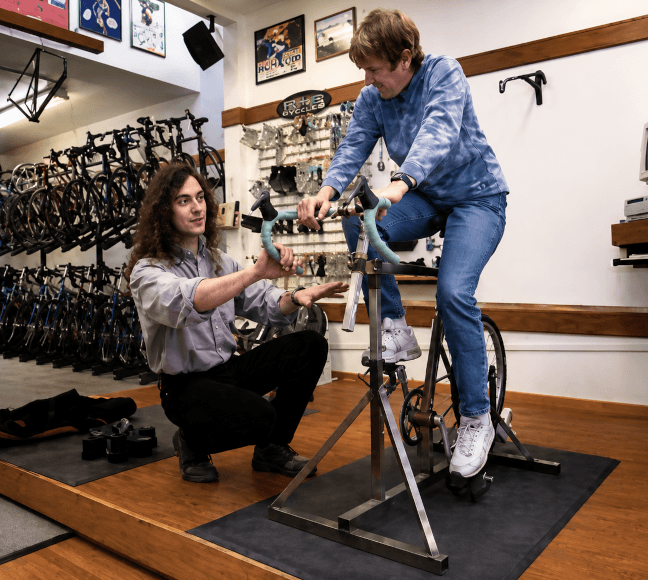
Photo - ELLEN M. BANNER / THE SEATTLE TIMES - 2003
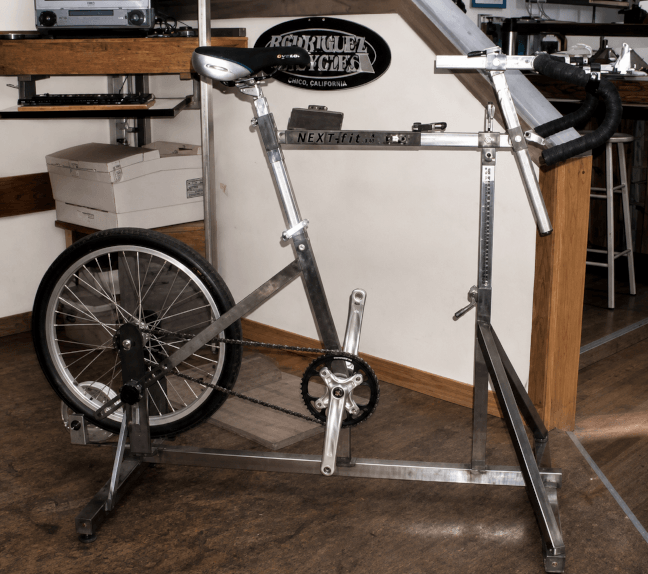
Our first version of a fit bike (1990's)
Making an adjustment could take several minutes, and every change required the rider to stop pedaling and dismount the bike. Once the adjustment was complete, the rider had to get back on and try to remember how the previous position felt.
It was better than guessing, but it wasn’t good enough.
As we redesigned our manufacturing process in 2006, we started asking ourselves a simple question:
Why shouldn't our fitting procedure be as efficient as our new frame shop design?
We needed to make adjustments while the rider was pedaling. This way riders could feel a change instantly and tell us whether it felt better or worse.
So we built a bike that could do exactly that.
Building the NextFit™ Bike
The NextFit™ bike was unlike anything that existed in the bicycle fitting world at the time. Every major adjustment could be made while the rider remained on the bike and continued pedaling. I don't know how many shops have the ability to create anything they want, but our staff of rare birds pulled off something amazing.
Saddle position | Handlebar position | Reach| Height | Everything
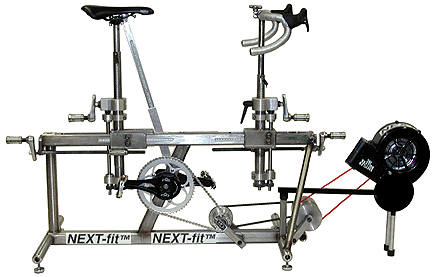
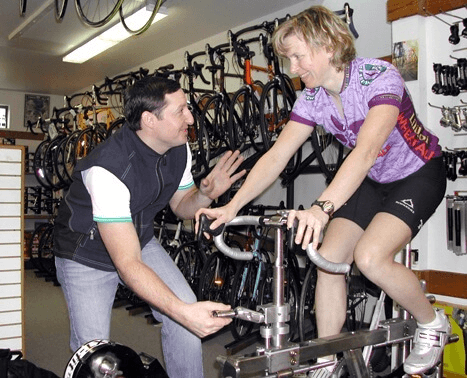
For the first time, riders could experience small changes immediately instead of trying to compare one setup to another from memory. The fitting process became faster, more accurate, and much easier for both the rider and the fitter. What surprised us most was how often riders could feel differences that were much smaller than we expected. A change that looked insignificant on paper could completely transform how a rider felt on the bike. Also, a custom fitting session could now be completed in roughly one-third the time.
The impact of our new creation extended way beyond our own shop.
Five years later, we started noticing something funny. Fit bikes that looked remarkably familiar began appearing in shops around the country. Eventually a major bicycle company manufactured and distributed its own version worldwide.
Apparently we weren't the only ones who thought the idea was useful.
One of the more amusing twists came in 2012.
While on vacation in Idaho, I walked into a bicycle shop and immediately recognized a fitting bike that looked remarkably familiar. It turned out the owner of a local machine shop had been hired to manufacture a copy of our original design. This was the guy making the bikes for the other company.
By then, our own NextFit™ bike had seen years of daily use and was beginning to show its age. The copy was built a little more heavily than our original version, so after a tour of his machine shop, I ended up buying one. To this day, that's the fit bike we still use in our showroom.
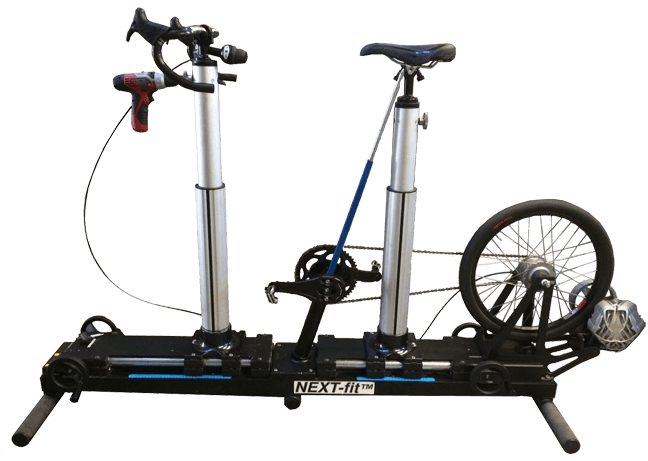
The new NextFit™ bike as we use it today in the shop
The Final Piece - Our Special Sauce
The NextFit™ bike solved one major problem: it allowed us to discover a rider's ideal position while they were actually pedaling. But that exposed a new challenge. Once we found the perfect position, how could we accurately translate that information into the design of a custom bicycle?
Fortunately, we had an unusual advantage (his name is Angel Rodriguez). Back in the 1980's Angel began computerizing our customers fit data. We had been collecting customer measurements and recording the dimensions of the bicycles we ultimately built for those riders. By 2006, we were sitting on a database containing tens of thousands of real-world fit records.
So we wrote software that connected those two worlds. Like everything else, we did this in house...because...well that's just how we do stuff here.
The fit bike helped us discover the ideal riding position. The software translated that position into a custom bicycle design. Together, they became the foundation of the NextFit™ system we still use today.
And that software led to an even bigger breakthrough....one that finally connected fitting, design, and manufacturing into a single seamless process.
I'll tell that story next time. But I digress. Now, back to the NextFit™ bike.
Interestingly, the fit bike itself was never the whole solution.
A fit bike is just a tool. Without the experience to interpret what the rider is feeling, and without the software to translate those findings into a bicycle design, it's not the whole picture. Anyone can own a fancy table saw, but that doesn't mean they can build nice cabinets.
The tool matters. But it's the system, and the people using it that produce the final result. Years of fitting experience can't be replaced by technology; technology can only help an experienced fitter work more effectively.
And even then, there is one final piece.
The greatest fitting system in the world doesn't mean much if you're limited to choosing from a catalog of pre-existing frame sizes and geometries.
The real power comes from being able to take everything learned during the fitting process and build a frame specifically around that rider. That's where being both a fitting company and a bicycle manufacturer makes all the difference.
An Unexpected Benefit
As we used the system, we discovered something unexpected. Many riders who came to us had physical limitations, old injuries, flexibility issues, or discomfort that they had simply accepted as part of cycling. The NextFit™ system often allowed us to find solutions that would have been difficult, or impossible to identify using traditional fitting methods.
Sometimes a small change in position transformed a rider’s comfort. Sometimes it allowed a rider to continue cycling when they thought their riding days might be ending. Those are some of the most rewarding fittings we do.
Looking Back
Just like the frame shop transformation, the NextFit™ system wasn’t a small improvement. It fundamentally changed how we think about custom bicycles. A custom bicycle isn’t simply a collection of custom dimensions. It’s a bicycle designed around a real person, in motion, doing the thing the bicycle was built to do.
That old newsletter really glossed over the intensity of the transformation our shop was .
By the end of 2006, we had solved two of the biggest challenges in custom bicycle building:
How to build a custom bicycle efficiently.
And how to fit a rider accurately.
Looking back, it's amazing how many of these ideas began as experiments, sketches, and "what if?" conversations in the shop. None of them would have become reality without customers willing to trust us, offer feedback, and take the journey with us.
Thank you for allowing us to build your bicycles and for being part of our 53-year story.
The stories I've been sharing in this email happened nearly twenty years ago, but the machines, tools, and ideas are still very much alive.
Thanks for reading. -Dan

Bicycles Hand Built in Seattle Since 1973
5627 University Way NE Seattle, WA 98105


